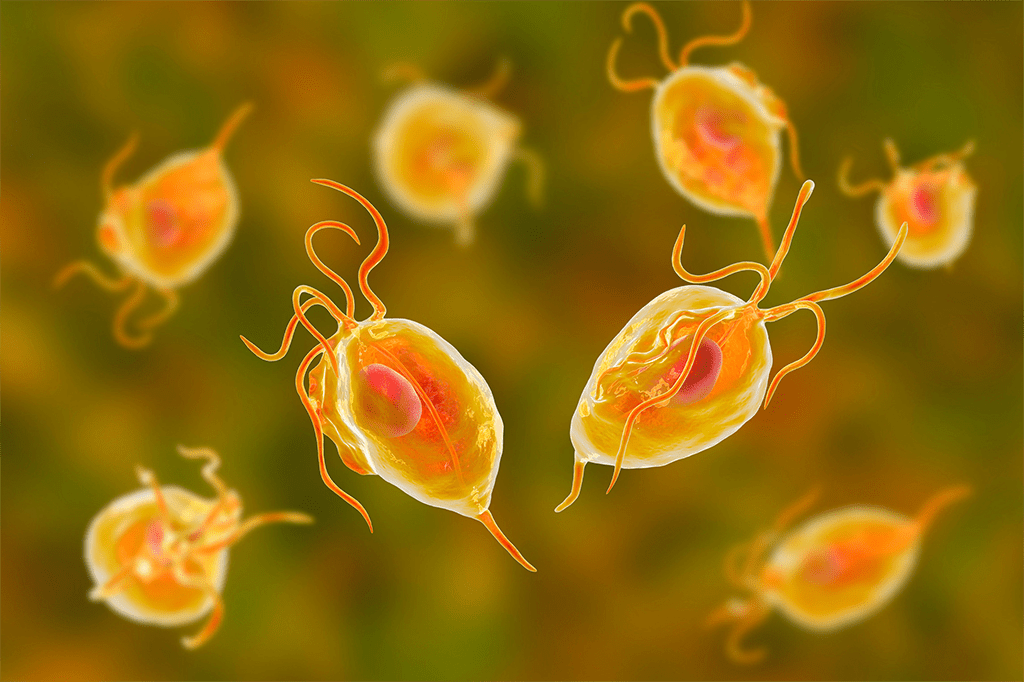
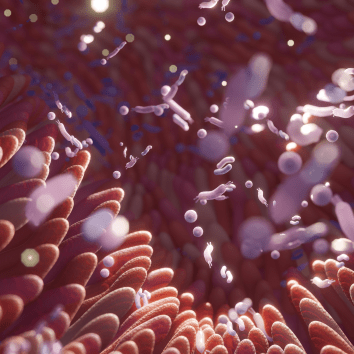
Many people think parasites only occur in far-flung countries, but nothing could be further from the truth. In this article, we explain what parasites are, why they're much more common these days, including in the Netherlands, and how you can discover if you (or your client) have them.
Definition of a parasite
In the broadest sense of the word, the term 'parasite' is used for any living being that uses another living being for its own survival, thereby disadvantaged the other life form.
In (medical-therapeutic) practice, a much more concrete and therefore more applicable definition is used: a parasite is a unicellular or multicellular, nucleated animal organism that lives at the expense of a human or animal host. In this definition, a parasite is therefore not a virus or bacterium.
Because parasites survive at the expense of their host, the host suffers the consequences. These disadvantages often manifest as various symptoms. It is also possible for parasites to "jump" from an animal host to a human host. This is called a zoonotic parasite.
Consequences of a parasitic infection
Parasitic infections are responsible for a wide range of symptoms, such as: squirting diarrhea, meteorism, projectile vomiting, subcutaneous growth and mobility, bodily discharge through the throat, eyes and skin and finally, high fever and comatose states.
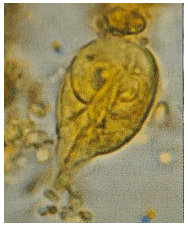
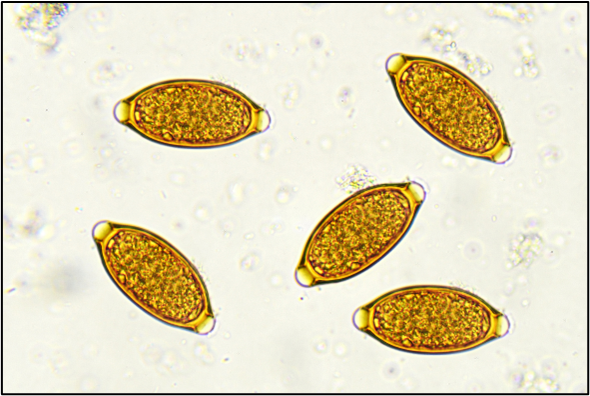
As an example, Figure 1a shows a whipworm (Trichiuris trichiura), and Figure 1b shows the eggs of this parasite. This parasite is responsible for diarrhea, anemia, and sometimes rectal prolapse.
Figure 1a. Microscopic image of Giardia lamblia
Figure 1b. Microscopic image of whipworm eggs
Parasites are not only a problem for far-away countries
Parasite infections have traditionally been associated with poor hygiene (particularly contaminated food), often combined with weakened immune systems due to malnutrition or other diseases. To this day, parasitic diseases remain a major threat to public health worldwide.
One of the best-known parasites is Plasmodium malariae, the causative agent of malaria. As is well known, this is one of the most common diseases worldwide, to which at least 409,000 people died in 2019 alone [https://www.who.int/news-room/fact-sheets/detail/malaria].
In traditional medical terms, parasitic infections are primarily a Third World problem. Unfortunately, the situation has changed considerably; it's no longer a distant concern.
In the remainder of this paper, we will limit ourselves to those parasites that occur in the human gastrointestinal tract. Parasites in other organ systems will not be considered further.
Why the risk of parasitic infections is increasing, also in the Netherlands
Here are three reasons why parasitic diseases have begun a second youth:
People are much more mobile than before. We now vacation in every corner of the world. In many of these (sub)tropical vacation spots, the risk of parasitic infection is much higher than in more temperate zones on Earth.
The average temperature on Earth is rising. While this has and will continue to have a significant impact on the economy and society, the spread of (sub)tropical diseases to previously cooler regions is a direct consequence.
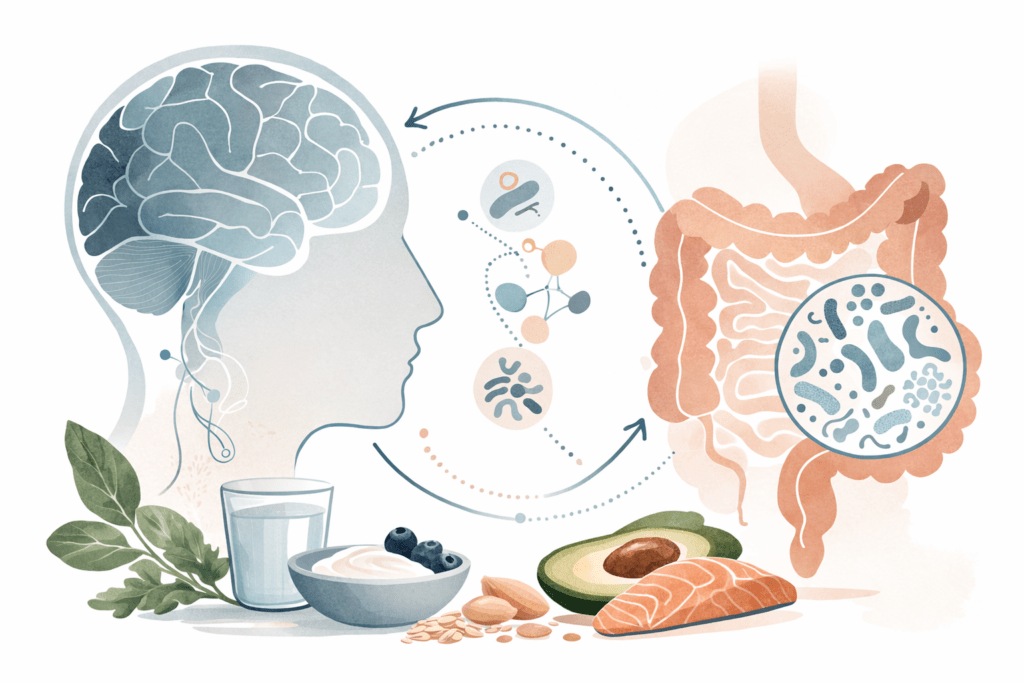
People are increasingly turning to 'organic' food. This primarily involves increased quantities of vegetables produced without the use of pesticides. Although consuming this type of food offers significant health benefits, this organic vegetable production is also highly vulnerable to parasitic contamination. Many vegetable gardens and farms are visited by animals. Many of these animals (primarily dogs, cats, birds, mice, and rats) carry parasites in their intestinal tracts, which end up in the soil and on the growing vegetables via their feces. Many of these parasites are zoonoses and can make people sick. This occurs particularly in hobby or artisanal vegetable cultivation (kitchen gardens!), where the mandatory rinsing of harvested plants is not always carried out adequately. The parasites that can remain on poorly or unwashed vegetables pose a real danger to consumer health. (Figure 2)
The use of ditch water for the irrigation of organically grown vegetables. This is essentially a variation on what was described above. Waterfowl also carry parasites in their intestinal tracts. These parasites can end up in ditch water through feces. Especially in summer, when the water is warm, these parasites (and their eggs and cysts) can survive in the water for a long time.
Although exact figures for the Netherlands are not available from the National Institute for Public Health and the Environment (RIVM), it is clear that the risk of parasitic infections has increased and will probably increase further.
Figure 2: Organic vegetables: healthy or dangerous?
Parasite research, a brief introduction
Parasite testing has been performed in medical laboratories for decades. Traditionally, classical microscopic methods were used, but more recently, more advanced DNA detection techniques have also been employed.
Classical microscopic laboratory techniques can handle a wide variety of samples, but they are not as specific. Advanced DNA methods are less diverse than microscopy, but more specific.
Recently, a highly advanced alternative has become available, combining microscopy and DNA detection technology. This is Fluorescence In Situ Hybridization, or FISH. We are the only company in the Netherlands to routinely offer this analysis.
Figure 3 A parasitological analyst in action
Why test for parasites at NL-Lab?
Choosing NL-Lab has a number of clear advantages:
NL-Lab uses advanced technology that combines the best of classical and modern methods. As mentioned above, this technology offers the analytical bandwidth of classical microscopy and the specificity of modern DNA detection methods.
NL-Lab analyzes for 16 parasite species. This is the most comprehensive test package available compared to what other private laboratories offer.
NL-Lab is one of the most economical providers. At NL-Lab, the interests of the practitioner and the patient come first, also in terms of affordability.
At NL-Lab, you're not just a number. You can discuss your test results free of charge. Our microbiology experts are available during the week for questions.
NL-Lab analyses are available to doctors, therapists, and private individuals . Therefore, you do not need a referral .
All in all, five clear reasons to choose NL-Lab's comprehensive parasite research.
I am interested in a parasite test
In the Netherlands, it used to be common for a parasite test to be requested by a doctor or GP. Recently, doctors, therapists, and private individuals can now contact NL-Lab.
Are you a doctor or therapist?
Register here without obligation. After registration, you can request test kits. We will then send you a number of test packages free of charge, which you can give to your client during consultations. Upon request, we also send test packages directly to your client free of charge.
Are you a private individual?
You can order the parasite test directly from our webshop. You'll then receive a package with all the necessary supplies and detailed instructions for successfully submitting your sample to NL-Lab.
In conclusion
Parasites pose an increasing threat to health. The availability of modern and adequate testing methods is an integral part of preparing for this future. NL-Lab offers the most comprehensive parasitological testing for both practitioners and individuals at an attractive price.